Design and Experimental Evaluation of a Marker-Based Augmented Reality Solar System Learning System Integrating Cultural Values
Keywords:
Augmented realityeducational technology engineeringexperimental validationmarker-based trackingsolar system simulationAbstract
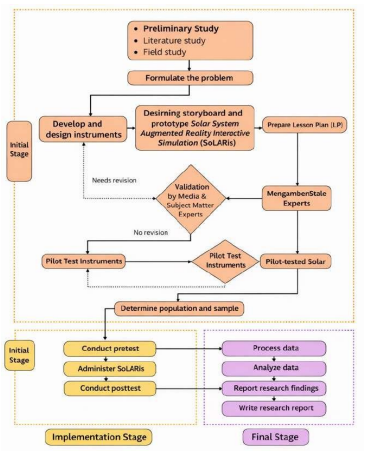
Thisstudy presents the design and experimental evaluation ofsolarsystem augmented reality interactive simulation (SolARis), a marker-based augmented reality (AR) learning system developed to enhance the visualization of solar system concepts in higher education. The system was engineered using Unity 3D integrated with the vuforia software development kit (SDK) and structured through the 4D development framework. The architecture consists of a content layer, AR engine layer, and application layer to ensure stable marker detection, real-time three-dimensional rendering, and efficient deployment on Android-based devices. Experimental validation was conducted across three higher education institutions to assess system validity, practicality, and effectiveness. Expert evaluation produced a very high validity score (4.85), while student responses indicated very high practicality (4.52). Learning effectiveness analysis yielded a medium normalized gain (N-Gain) value of 0.46, demonstrating measurable conceptual improvement after AR-assisted instruction. Rasch model analysis confirmed strong measurement consistency, with person reliability of 0.81 and item reliability of 0.85. The findings indicate that the integration of marker-based tracking, optimized 3D modeling, and structured instructional flow results in a technically robust and scalable AR learning system. SolARis contributes to engineering-oriented educational technology by providing a validated AR-based solar system learning platform suitable for multi-institutional deployment